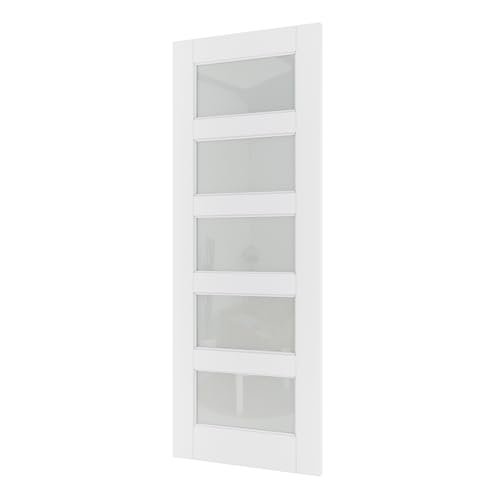
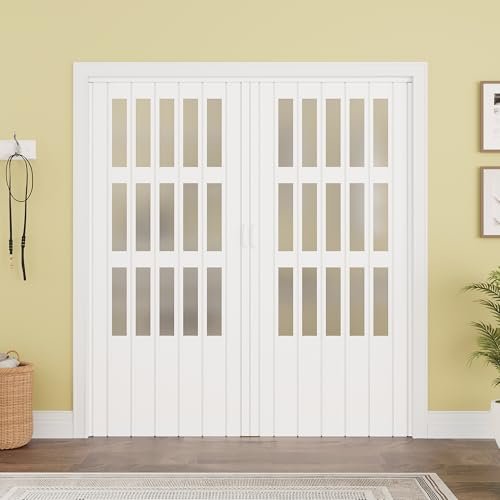
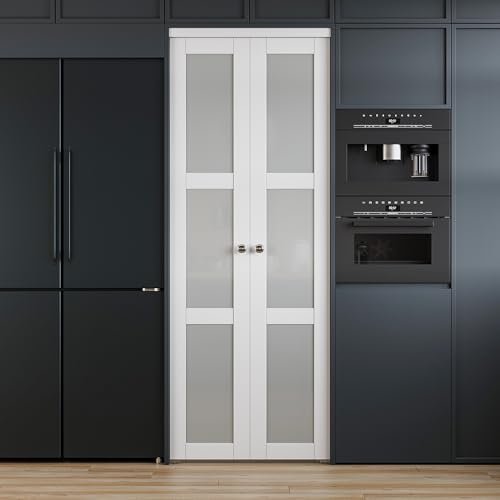
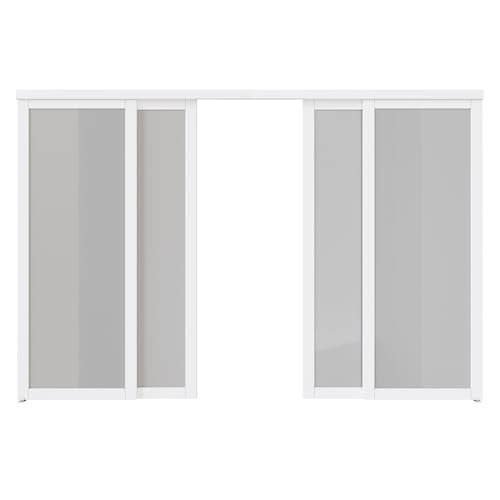
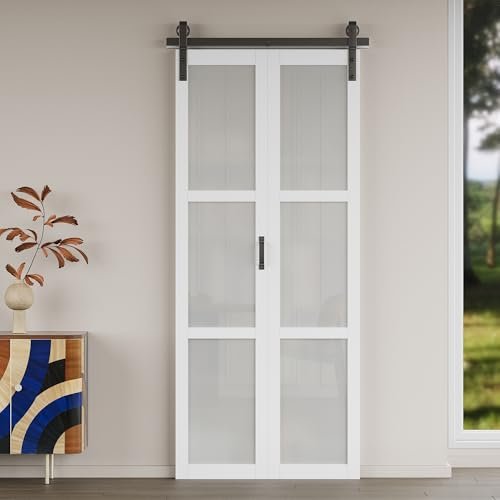
Every WIN STELLAR MDF door panel uses CARB P2 certified material — the California Air Resources Board Phase 2 standard for low-emission composite wood, the same benchmark required for professional-grade interior millwork.
All glass panel products — frosted, clear, and mirror configurations — use SGCC-certified tempered glass engineered to break into blunt fragments rather than sharp shards, relevant for closets, pantries, and laundry rooms where people reach past the glass daily.
Track, hinges, knobs, guides, and mounting hardware are included across all five product lines — accordion, slab, pivot, sliding, and bifold barn — so nothing is missing when you open the box on installation day.
WIN STELLAR answers seller messages within 24 hours regardless of business days or holidays, and ships replacement panels within one business day when damage occurs in transit — confirmed across product listings on Amazon, Wayfair, and Home Depot.
WIN STELLAR's five lines — accordion folding door, interior door slab, French pivot swing door, sliding closet door, and bifold barn door — address different opening types, wall clearance constraints, and access requirements, but share the same construction standard: solid core or double-walled panels, certified materials, and complete hardware kits in every box. The right line depends on your opening, not on which one looks best in a listing photo.
Multi-panel PVC doors that fold to roughly 10% of the opening width — the practical choice when a swing door or bypass slider won't fit. Available in single-layer and double-walled construction for openings from 24" to 120" wide, with trimmable panels for off-standard doorways.
Pre-assembled solid core panels in frosted glass, mirror, clear glass, and solid configurations — sized from 18" to 36" wide and 80" to 96" tall. Requires an existing frame in good condition. Triple-primed paint-grade surface means it matches your trim color exactly without staining.
Two-panel doors that rotate on top and bottom pivot hardware rather than side-mounted hinges, covering openings from 24" to 60" wide. SGCC-certified frosted glass and mirror options. The pivot mechanism eliminates the hinge gap and gives both faces of the door a clean reveal.
Bypass mirror doors for wide closet openings — available in solid wood frames (48" to 120" wide) and aluminum frames with explosion-proof mirror backing. Hardware tested to 100,000+ open/close cycles, top-track-only design leaves the floor undamaged.
Two-panel doors that fold flat against the wall beside the opening and hang from a top-mounted barn track — no floor track required. Available in frosted glass, full mirror, and hollow core configurations from 36" to 64" wide. Complete hardware kit including track and handle ships in every box.
Browse the complete brand catalog with up-to-date pricing on Amazon.
These 12 represent the spread of what buyers actually install — a 30×80 slab going into an existing pantry frame, a 120" bypass mirror replacing a dated closet setup, a 36" accordion folding a utility room alcove shut. The selections below pull from all five lines because the right door depends on your opening type, not on which category happens to rank higher.
WIN STELLAR's interior slab line covers widths from 18" to 36" and heights of 80" or 96", all in solid core CARB P2 certified MDF with SGCC-certified tempered frosted glass. Every panel ships triple-primed and fully assembled — no sanding, no priming, no sourcing hardware separately. These are slab-only panels: they require an existing frame in good condition. If your frame is damaged or missing, a prehung unit or top-mounted system is the better call. The line holds the #2 ranking in Hinged Interior Solid Core Doors on Amazon.
A slab door requires an existing frame in good condition. That's the starting point — before width, before glass style, before anything else. If your jamb is rotted, badly out of square, or missing entirely, a slab won't work and you need a top-track system instead. Assuming the frame is solid, here's how to find the right WIN STELLAR slab size.
Every door opening has three relevant measurements, and they're not interchangeable:
The most common mistake: measuring the rough opening and ordering a door that size. A 30-inch rough opening needs a 28-inch slab, not a 30-inch slab. The panel has to fit inside the jamb, not the framing.
| Panel Width | Panel Height | Fits Finished Opening | Fits Rough Opening | ASIN |
|---|---|---|---|---|
| 18" | 80" | 18-1/4" × 80-1/2" | 20" × 82" | B0DY69G5D7 |
| 24" | 80" | 24-1/4" × 80-1/2" | 26" × 82" | B0CH34CDN7 / B0CG9DMYV8 |
| 26" | 80" | 26-1/4" × 80-1/2" | 28" × 82" | B0DCZJJHXZ |
| 28" | 80" | 28-1/4" × 80-1/2" | 30" × 82" | B0CH34BKFL / B0CS694FDG |
| 30" | 80" | 30-1/4" × 80-1/2" | 32" × 82" | B0G4CM4HXR |
| 32" | 80" | 32-1/4" × 80-1/2" | 34" × 82" | B0CG9DQXD1 |
| 36" | 80" | 36-1/4" × 80-1/2" | 38" × 82" | B0DCC7SKC9 |
| 24" | 96" | 24-1/4" × 96-1/2" | 26" × 98" | B0DCC25127 |
All panels are 1.4 inches thick (approximately 1-3/8 inches), which is the standard slab thickness for interior doors. The 30×80 panel (B0G4CM4HXR) weighs 28 pounds — plan accordingly if you're hanging it alone.
Yes — WIN STELLAR slabs are trimmable up to 0.5 inches per side, which means you can take up to 1 inch off the total width. That's enough to fit an opening that's slightly undersized or an old frame that's settled out of true. But contact WIN STELLAR through Amazon seller messaging before cutting — the brand provides specific guidance on sealing trimmed edges to prevent moisture absorption into the MDF core, which matters for long-term durability.
A slab is the right choice when your jamb is in good shape and you're replacing an existing door panel — not the frame. It's faster, cheaper, and requires no drywall repair. A prehung unit — or a top-track system like the accordion or bifold barn lines — is the right choice when the frame is damaged, missing, or when you're putting a door in a new opening. Trying to retrofit a slab into a damaged frame creates alignment problems that no amount of shimming will fully correct.
One more thing worth knowing: WIN STELLAR slabs ship without hardware. No hinges, no knob, no latch. If your existing hardware fits the new door's thickness (1.4 inches), you can reuse it. If not, you'll need to source that separately before installation day.
WIN STELLAR's accordion line runs from 24" to 120" wide across nine products in three distinct construction tiers: single-layer PVC (0.23" thick panels), double-walled PVC (0.46" thick, the double-wall models scoring 4.7 stars), and double-layer PVC with frosted acrylic insets. Every model is trimmable in both width and height, all hardware ships in the box, and the folded panel stacks to as little as 2.7" wide — roughly 10% of the opening. Full-side magnetic strips keep the door shut against pets, drafts, and accidental contact. No frame is needed; the track mounts to the header above the opening.
WIN STELLAR's accordion line has three distinct construction tiers, and they're not interchangeable. The right tier depends on where the door lives, how often it gets used, and whether it needs to look good from both sides. Buying the wrong tier — typically buying down — is the source of most accordion door disappointment.
Tier 1 — Single-layer PVC: One layer of flexible PVC, either 0.23 inches thick. Folds tightly, installs fast, weighs very little. The surface has a UV-resistant clear coat that resists discoloration from kitchen fumes, which is actually a practical feature if the door sits near a range. This tier is appropriate for utility closets, laundry rooms, basements, RV doorways, and any space where you need to close off an opening without spending much money or caring about the look from both sides. It won't feel solid when you push on it. That's not a flaw — it's what single-layer PVC is. Available in black (B0G1C5LM7V), walnut (B0FXXDMF2S), and white (B0FRRWY9TQ, B0GSB29ZX4).
Tier 2 — Double-layer PVC: Two walls of PVC with an air gap between them, 0.46 inches total thickness. Noticeably stiffer than single-layer. The double-wall construction adds enough rigidity that pushing on the middle of the door doesn't produce the flexible ripple that makes cheap accordion doors feel cheap. The full-side magnetic strip on the double-wall models (B0GR5JC532, B0GR5PQN95) is also more effective than the single-strip closures on budget options — it creates a seal tight enough that pets can't bump it open, which shows up repeatedly in the product listing as a real use case. This tier is appropriate for kitchens, home offices, bedroom closets, and spaces where the door gets used multiple times daily. Rated 4.7 stars across 7 reviews.
Tier 3 — Double-layer PVC with frosted acrylic panels: Same double-wall PVC frame construction as Tier 2, but with three frosted acrylic panel inserts that transmit diffused light. This is the tier that looks like a door rather than a functional divider. It's appropriate for living rooms, home offices, and any space where aesthetics matter and you want natural light to pass through without direct visibility. The 36-inch version (B0CLDJZQ6D) weighs 17.5 pounds and includes 2 handles. The 72-inch version (B0DM248T49) includes 4 handles. Both rate 4.6 stars across 15 reviews.
| Model | Panel Size | Fits Openings | Folds To | Tier | ASIN |
|---|---|---|---|---|---|
| PVC Accordion Door 36×80 Black | 36" × 80" | 24"–36" | 2.7" | Single-layer | B0G1C5LM7V |
| PVC Accordion Door 36×80 White | 36" × 80" | 24"–36" | 2.7" | Single-layer | B0FRRWY9TQ |
| PVC Accordion Door 48×80 Walnut | 48" × 80" | 37"–48" | 3.3" | Single-layer | B0FXXDMF2S |
| PVC Accordion Door 72×80 White | 72" × 80" | 61"–72" | 5.4" | Single-layer | B0GSB29ZX4 |
| Frosted Acrylic Accordion Door 36×80 | 36" × 80" | 24"–36" | — | Double-layer + acrylic | B0CLDJZQ6D |
| Frosted Acrylic Accordion Door 72×80 | 72" × 80" | 61"–72" | — | Double-layer + acrylic | B0DM248T49 |
| Double-Wall Accordion Door 60×80 | 60" × 80" | 49"–60" | — | Double-wall PVC | B0GR5PQN95 |
| Double-Wall Accordion Door 120×80 | 120" × 80" | 97"–120" | — | Double-wall PVC | B0GR5JC532 |
Width trimming works by removing panels from the track — you don't cut the door material itself. Height adjustment requires trimming the panel. After either adjustment, the folding tightness changes slightly but the door's finished appearance doesn't.
Accordion is the right call when wall clearance is the binding constraint. A 36-inch accordion collapses to 2.7 inches — less than the width of a standard door stop. No other door type comes close. Bypass sliding doors stay within the opening width when operating but require adjacent wall space for the track header. Bifold barn doors need adjacent wall equal to their folded width. For RV doorways, narrow hallway closets, mobility-access situations, or any space where you're standing on a stepladder wondering how you'll get a barn door track mounted, the accordion is often the only practical answer.
Where accordion doesn't win: any space where sound isolation matters. The flexible PVC panels don't seal against the jamb the way a solid-core slab does, and the hinge connections between panels let sound pass. For laundry rooms adjacent to bedrooms or home offices where noise bleed is a real issue, a slab or solid-core bifold barn door will outperform any accordion configuration.
WIN STELLAR's French pivot line uses top-pin and bottom floor-plate hardware rather than side-mounted hinges — which means no hinge gap, a cleaner reveal on both faces, and a double-panel swing from a single opening. The line covers 24", 30", 36", 48", and 60" opening widths in frosted glass (3-lite) and full mirror configurations, all with 0.83" solid core panels and SGCC-certified glass. Hardware kits and a knob ship with every panel. Be honest about this line: it carries a 3.1-star rating across 30 reviews, and installation precision matters more here than with any other WIN STELLAR product. The top pin and bottom plate both require accurate placement — a few millimeters off and the door binds.
The WIN STELLAR French pivot door line has the lowest ratings in the catalog — 3.1 stars across 30 reviews. That's worth addressing directly, because the pivot door itself isn't the problem. The mechanism is sound. The issue is that pivot hardware installation requires a level of precision that catches buyers off guard, especially those who've installed standard hinge-hung doors before and assume the process is comparable. It isn't.
A traditional hinge-hung door rotates on side-mounted hinges attached to the jamb. The weight is distributed across three hinge points, and small alignment errors are forgiving — a slightly misaligned hinge just makes the door harder to open, not impossible to hang.
A pivot door rotates on a top pin set into the header and a floor plate set into the floor (or mounted to a base plate at the bottom of the opening). The door doesn't touch the jamb at any point during operation — it swings freely on the two pivot points. That's what creates the clean reveal with no hinge gap visible on either face of the door. But it also means both pivot points have to be in precise vertical alignment. If the top pin and floor plate are off by more than a few millimeters, the door won't seat correctly, will drag on the floor, or will swing open on its own.
WIN STELLAR's pivot doors use top-mounted roller hardware and a floor-level pivot point. Door panel thickness is 0.83 inches across all sizes. Panels ship pre-assembled with SGCC-certified frosted glass (3-lite configuration) or full mirror panels. Each panel ships with a complementary knob included.
Pivot doors swing into the room on an arc equal to the panel width. For a 30-inch opening (B0DD7HQ3QX), each panel is approximately 15 inches wide — the arc of each panel extends 15 inches into the room from the pivot point. For the 60-inch opening version (B0DD7GGGXK), each panel is 30 inches wide. Measure the room side of the opening and confirm nothing sits within that arc: furniture, appliances, shelving. In a pantry or laundry room where shelving often runs floor to ceiling on all walls, that arc can be a real constraint.
Height adjustment exists: for openings between 80.25 and 80.75 inches tall, the roller hardware adjusts upward to compensate. Below 80 inches or above 80.75 inches is outside the specified range.
The 24-inch (B0DJF8QKY3) and 30-inch (B0DD7HQ3QX) sizes are the most manageable for a careful DIYer. The panels are lighter, the swing arc is shorter, and a mistake in floor plate placement is easier to correct. Dry-fit everything before drilling. Set the top pin first, then position the floor plate directly below it using a plumb bob or laser level — not eyeballing. That vertical alignment is the single step that most installation problems trace back to.
The 48-inch (B0DD7JLNX9) and 60-inch (B0DD7GGGXK) versions involve heavier two-panel configurations and wider swing arcs. They're still DIY-possible, but the margin for error on the floor plate placement is smaller because the longer panels amplify any misalignment more dramatically. If you're not comfortable with a plumb line and a drill guide, the 48 and 60-inch sizes benefit from a second set of hands — not necessarily a professional, just someone who can hold the panel plumb while you set the hardware.
Custom pivot door manufacturers — Frits Jurgens, Pivot Door Company of Colorado — build steel-cased pivot systems that start at several thousand dollars per door. Those systems use concealed floor boxes and architectural-grade hardware designed for doors weighing hundreds of pounds. WIN STELLAR's pivot doors are a different product category entirely: pre-assembled solid core panels at 0.83 inches thick, shipped with all hardware included, designed for residential interior openings in the 24-inch to 60-inch width range. The pivot mechanism is the same fundamental concept — top pin and floor plate — but scaled to interior door weights rather than architectural statement pieces.
The 0.83-inch panel thickness is thinner than the slab line's 1.4 inches, which matters if you're comparing sound isolation performance. For a pantry or laundry room application — the typical use case — the difference is minor. For a home office or bedroom where noise reduction is the priority, the slab line's solid-core CARB P2 MDF at 1.4 inches is the better technical choice.
The 3.1-star rating is real and shouldn't be dismissed. But reading through what generates the negative reviews, installation difficulty accounts for most of it — not material failure, not hardware quality, not the glass. The brand acknowledges this: WIN STELLAR has an Amazon Live installation video for the pivot line specifically, which is worth watching before the door arrives rather than after. A door that installs correctly rates significantly higher than the category average suggests.
WIN STELLAR's sliding line divides into two clearly different product types: solid wood frame bypass mirrors (rated 4.0 stars across 48 reviews, available in 48", 60", 96", and 120" widths) and aluminum frame sliding doors (rated 4.9 stars across 15 reviews, available in mirror and clear glass). Both types run on top-mounted tracks with adjustable floor guides — no bottom track cuts into carpet or hardwood. Hardware has been tested to 100,000+ open/close cycles. The bypass limitation applies to both types: only half the opening clears at any time, because the two panels slide in front of each other rather than folding out of the way.
WIN STELLAR's sliding closet door line has two completely different construction types, and they serve different buyers. Choosing between them matters more than which size you pick — get the construction type wrong and the door will either underperform your expectations or outlast the closet it's installed in by decades more than you needed.
The wood-framed bypass sets (B0D9BDWWXG, B0C9DF9NG2, B0D9BC8YV8) use a solid wood frame with explosion-proof mirror backing, top track with adjustable floor guide, and 0.83-inch panel thickness. Hardware is rated to 100,000+ open and close cycles. These panels are prefinished with a PVC surface — they can't be painted. The mirror is one-sided; the back is covered in white explosion-proof film. They rate 4.0 stars across 48 reviews.
The aluminum-framed sets (B0CCS3F1P2, B0G7WSWHH8, B0G7X3CN91) use an aluminum alloy frame — noticeably heavier-looking and more resistant to the frame flex that causes wood-framed bypass doors to rattle over time. Panel thickness is 1.18 inches, measurably more substantial than the wood-framed 0.83 inches. The aluminum models require no assembly. They rate 4.9 stars across 15 reviews — a meaningful gap from the wood-framed version. The aluminum line includes mirror and clear glass options; the clear glass model (B0G7WSWHH8) is the only transparent option in the entire WIN STELLAR sliding line.
Honestly, if your budget allows for the aluminum-framed versions, they're the better long-term choice. The 4.9-star rating versus 4.0 isn't random — aluminum frames don't warp, don't flex, and don't develop the rattle that wood-framed bypass doors eventually acquire.
Every bypass sliding door — regardless of brand, regardless of construction quality — only clears half the opening at once. That's not a WIN STELLAR limitation; it's how bypass doors work. Both panels slide on parallel tracks, passing in front of each other. At any given position, one panel covers the left half of the opening and the other covers the right half. You access one side or the other, never the full width simultaneously.
For a wide reach-in bedroom closet, this is usually fine. You access one side, then slide the door to access the other. The inconvenience is minimal when you're just reaching in for a shirt.
For a pantry — where you're often standing directly in front of the opening trying to find something on the back of a shelf — bypass function creates real friction. You can't see the full pantry contents in a single glance. If that matters to you, consider the bifold barn door line or the accordion line instead. Both clear the full opening width.
One Home Depot review for the wood-framed sliding door line specifically flags high VOC off-gassing after installation. This is worth acknowledging honestly rather than glossing over. MDF products — which make up the core of the wood-framed panels — can off-gas formaldehyde and other volatile compounds in the days immediately following installation, particularly in enclosed spaces with limited air circulation. Ventilating the closet space for 48 to 72 hours after installation reduces exposure. This applies to the wood-framed line; the aluminum-framed panels use different materials and don't carry the same documented concern.
| Opening Width | Each Panel | Frame Type | Mirror/Glass | ASIN |
|---|---|---|---|---|
| 46"–49" | 25" × 78-9/16" | Wood | Mirror | B0D9BDWWXG (96" set, 4 panels) / see note |
| 58"–61" | 31" × 78-9/16" | Wood | Mirror | B0C9DF9NG2 |
| 92"–98" | 25" × 78-9/16" | Wood | Mirror | B0D9BDWWXG |
| 116"–122" | 31" × 78-9/16" | Wood | Mirror | B0D9BC8YV8 |
| ~48" | 24.33" × 78.35" | Aluminum | Clear glass | B0G7WSWHH8 |
| ~60" | 30.35" × 78.35" | Aluminum | Mirror (white frame) | B0CCS3F1P2 |
| ~120" | 30.35" × 78.35" × 4 panels | Aluminum | Mirror (black frame) | B0G7X3CN91 |
The wood-framed 96×80 set (B0D9BDWWXG) fits openings from 92 to 98 inches wide. All bypass sets include top track — no floor track is drilled into the floor, only the adjustable bottom guide. The track can be cut to fit a smaller opening if needed.
Bypass sliding doors aren't the answer for anyone who needs full opening access in a single motion. They're also not the right call for buyers who hate the idea of doors that can only be used partially at a time — Reddit's r/homeowners has an entire thread titled "Sliding closet doors — do they inherently suck?" with thousands of upvotes, and the core complaint is always the half-access limitation. If that resonates with you before you've even bought the door, the accordion or bifold barn line will serve you better.
WIN STELLAR's bifold barn line ships five products: two frosted glass configurations (36" and 40" wide), two full mirror configurations (36" and 50" wide), and one hollow core option at 64" wide. All five include the barn track, handle, and complete mounting hardware — nothing ships separately. The frosted glass models use SGCC-certified tempered glass at 1/6" thick, which is 33% thicker than standard competitors per product specifications. Panels are pre-assembled solid core MDF. The Wayfair aggregate across the bifold barn line sits at 4.4 stars across 106 reviews — the strongest confidence signal in the WIN STELLAR catalog. Wall clearance is the main constraint: each folded panel needs adjacent wall space equal to its open width.
A bifold barn door clears the full opening width when open — but it needs somewhere to go. The folded panels stack against the wall beside the opening, and if there isn't enough wall there, the door physically cannot open fully. This is the single most common installation surprise with bifold barn doors, and it's worth mapping out before you order rather than after the door arrives.
When a bifold barn door opens, the two panels fold toward each other and the assembly slides along the track to the side of the opening. The folded width — both panels stacked together — determines how much adjacent wall you need. For WIN STELLAR's bifold barn doors, which use 1-1/6-inch thick panels, plan for the following minimum clear wall space beside the opening:
| Door Width | Panel Count | Each Panel Width | Folded Stack Width | Recommended Wall Clearance | ASIN |
|---|---|---|---|---|---|
| 36" | 2 | 18" | ~18"–19" | 20" minimum | B0CNRMMFSW / B0CNRPX715 |
| 40" | 2 | 20" | ~20"–21" | 22" minimum | B0CNRQVVPH |
| 50" | 4 (12.5" each) | 12.5" × 4 | ~25"–26" total | 28" minimum | B0CNRQV9VT |
| 64" | 6 (approx. 10.7" each) | ~10.7" | ~32"–33" total | 35" minimum | B0FG82ZHDY |
"Minimum" means the door can fold fully open. You'll also want a few extra inches of practical clearance so the folded door doesn't press against the wall surface, which causes marks on painted walls over time. A good rule of thumb: add 2 inches to the folded stack width as the true usable clearance requirement.
The clearance needs to be clear wall — not a doorway, not a window frame, not a return wall corner, not a light switch. A Reddit thread on bifold barn doors summarizes it well: "When they were open they blocked the wall" is the complaint that shows up repeatedly when buyers measure the opening but not the landing zone. Measure from the edge of the opening to whatever interrupts the wall beside it. That number needs to exceed the minimum clearance above.
If it doesn't, you have two practical alternatives: an accordion door (collapses to 2.7 to 5.4 inches depending on size — see the accordion guide above) or a single sliding barn door that stacks against the wall in one panel rather than folding. The accordion is the lower-cost solution; a single barn door is the more dramatic visual one.
The 36×84 frosted glass version (B0CNRPX715) fits openings of 35" wide by 83" tall and uses 1/6-inch SGCC-certified tempered glass — 33% thicker than comparable products per the product listing. The white primed MDF surface accepts paint, so you can match it to your trim color. This is the right call for pantries and laundry rooms where you want diffused light and a clean, paintable look. Rated 4.7 stars across 8 reviews.
The 40×84 frosted glass version (B0CNRQVVPH) fits openings of 39" by 83" and includes a 44-inch track. Same SGCC-certified glass, same white primed finish, same solid core construction. The extra 4 inches of width suits slightly wider openings than the 36-inch model.
The 36×84 mirror version (B0CNRMMFSW) is the same panel dimensions as the frosted glass model but with full HD mirror panels instead of glass. At 55 pounds, it's the heaviest bifold barn door in the line — plan for wall anchors that can handle that load on the track. Package includes 40-inch track, handle, and all hardware. The Wayfair listing for the bifold barn door line shows 4.4 stars across 106 reviews, which is the largest review pool and the most reliable signal of long-term satisfaction.
The 50×84 mirror version (B0CNRQV9VT) uses 4 panels of 12.5 inches each with two separate 29-inch tracks — one for each pair of panels. The opening requirement is 49" by 83". At 5.0 stars from 2 reviews, the sample size is too small to draw firm conclusions, but no negative signals exist yet.
The 64×84 hollow core version (B0FG82ZHDY) is the only entry-level option in the bifold barn line — 6 panels, hollow core construction (not solid core MDF like the others), 72-inch track, fits openings up to 62 inches wide by 83 inches tall. It's unfinished or primed and requires at least 92 inches of ceiling height for proper installation. This is the option for buyers who need to cover a wide opening on a budget and are willing to paint the door themselves. It's the right call to be transparent: hollow core construction transmits sound significantly more than the solid core MDF panels in the rest of the line. One Houzz commenter compared bifold barn doors to a screen door for sound — that critique applies here specifically, not to the solid core versions.
None of the bifold barn door configurations match the sound isolation of a solid slab door in a traditional jamb. The track mounting leaves gaps at the top and sides of the opening that slab doors eliminate. The solid core MDF versions reduce noise noticeably compared to hollow core, but if acoustic separation is the primary requirement — home studio, bedroom with a loud hallway — a solid slab hung in a proper jamb with a door sweep is the more effective solution. The bifold barn door wins on aesthetics and full opening access. It's an honest trade-off, not a failure of the product.
The right WIN STELLAR door starts with one measurement and three yes/no questions. Get those right and the style choice takes care of itself. Get them wrong and you'll be returning a door that was never going to fit your opening in the first place.
Start with your opening. Measure the width and height of the finished opening — the space between the jamb faces, not the rough framing. That single number eliminates most wrong choices immediately. A 24-inch opening rules out anything in the sliding bypass line. A 120-inch closet opening rules out a single slab. Write the number down before you look at anything else.
If the jamb is in good shape — no rot, no out-of-square that exceeds about half an inch — a WIN STELLAR interior door slab is the lowest-disruption option. The slab drops into the existing frame. No drywall work, no rough framing adjustment. The 10 slab sizes cover widths from 18 inches to 36 inches and heights of 80 or 96 inches, all at 1.4 inches thick with CARB P2 certified MDF construction. If the frame is damaged, missing, or you're creating a new opening, one of the top-track systems — accordion, bifold barn, or sliding bypass — is the right call, since those mount to the header above the opening rather than relying on a jamb.
This is the question most buyers skip, and it's the one that creates the most returns. Sliding bypass doors and bifold barn doors need adjacent wall clearance equal to roughly half the door's total width when open. A 60-inch bypass set needs about 31 inches of clear wall on at least one side. A 36-inch bifold barn door folds to approximately 18 inches of stacked panels that have to land somewhere. Accordion doors are the exception — a 36-inch accordion collapses to 2.7 inches of stacked panel, which is why they work in hallways, RV doorways, and tight utility spaces where nothing else fits.
Bypass sliding doors — the mirror bypass sets in 48-inch, 60-inch, 96-inch, and 120-inch widths — only clear half the opening at once. That's fine for a wide reach-in closet where you can shift from one side to the other. It's a real problem for a pantry where you need to see and reach the full width in one motion. For full-width access, choose accordion, bifold barn, pivot French, or slab. The bifold barn doors clear the entire opening and fold flat against the adjacent wall. The accordion clears close to 90% of the opening width. Both are worth considering for pantry and laundry room applications where you're carrying things through.
WIN STELLAR's frosted glass options — 1-lite, 3-lite, 5-lite, and half-lite — all use SGCC-certified tempered glass that diffuses light while blocking direct sightlines. You can see that light is on in a pantry behind a frosted glass door, but you can't see what's on the shelves. That's the right call for most kitchen and utility applications. Clear glass, available in the aluminum-framed sliding door line, transmits full visibility both ways — suited for spaces where you want to see through, not into. Full mirror panels, available in the sliding bypass, pivot, and bifold barn lines, reflect rather than transmit — they add apparent depth to small rooms and work well in bedroom closets where a full-length mirror has functional value. Solid panels with no glass belong in bedrooms, bathrooms, or any space where light transmission isn't wanted at all.
Choose the interior door slab line if you're replacing an existing door in a functional frame, want a solid-core frosted glass panel that matches your trim paint exactly, and are comfortable mortising hinges or using your existing hinge locations. These are pre-assembled, triple-primed, and trimmable up to half an inch per side for frames that aren't quite standard.
Choose the accordion folding door line if wall clearance is limited, the opening is non-standard width, or the location is a utility space, RV, or mobility-access doorway. The three construction tiers — single-layer PVC, double-layer PVC, and double-layer with frosted acrylic panels — let you match the construction level to the use case rather than paying for more door than the space warrants.
Choose the French pivot swing door line if you want a double-panel frosted glass or mirror configuration that opens from the center without a center post, and you have room floor space in front of the opening for the swing arc. Read the installation guide before ordering — pivot hardware requires more precise alignment than top-track systems, and the 3.1-star rating on this line reflects buyers who skipped that step.
Choose the sliding closet door line for wide bedroom or hallway closet openings where bypass function is acceptable and you want mirror panels that make the room read as larger. The aluminum-framed versions rate 4.9 stars across 15 reviews and hold up measurably better than the wood-framed versions in long-term use. Hardware on both is rated to 100,000+ open and close cycles.
Choose the bifold barn door line if you need full opening access, want the look of a barn door without a single sliding panel, and have enough adjacent wall for the folded panels. The frosted glass versions use 1/6-inch SGCC-certified tempered glass — 33% thicker than comparable products per the product listing. The mirror version ships at 55 pounds with track, handle, and all hardware included.
Buyers comparing WIN STELLAR's solid-core frosted glass slab doors against Jeld-Wen and Masonite are making a real comparison between meaningfully different products — not just brand names. Here's what the specs actually show.
WIN STELLAR's interior door slab line uses CARB P2 certified MDF throughout — solid core, not hollow, across all 10 slab configurations. CARB Phase 2 is the California Air Resources Board's standard for formaldehyde emissions in composite wood products. It's the strictest emissions standard applied to interior millwork in the US, and meeting it is a meaningful production requirement, not a marketing badge.
Jeld-Wen's standard interior hollow-core doors — the ones commonly stocked at Home Depot — don't carry the same certification at the entry price point. Their solid-core lines do use denser construction, and some Jeld-Wen products carry CARB compliance, but it's not a universal specification across their interior door catalog the way it is for WIN STELLAR's slab line. Masonite's situation is similar: their hollow-core interior doors are the volume products, with solid-core options available at higher prices without universal emissions certification language in their standard listings.
This matters for one specific reason: buyers replacing doors in bedrooms, home offices, or homes with children are increasingly asking about indoor air quality from composite wood products. CARB P2 certification is the verifiable answer to that question.
WIN STELLAR's frosted glass slabs use SGCC-certified tempered glass — Safety Glazing Certification Council, the US standard confirming that the glass is heat-treated to break into blunt fragments rather than sharp shards. This is the relevant safety certification for glass in interior doors, particularly closet doors, pantry doors, and any door that gets reached past regularly.
Jeld-Wen and Masonite's glass interior door products also use tempered glass, and many carry similar certifications. This isn't an area where WIN STELLAR has an exclusive advantage — it's a standard the major manufacturers also meet. But it's worth knowing that WIN STELLAR's SGCC certification isn't a claim unique to their marketing; it's a verifiable third-party certification, the same category of standard the major brands use.
WIN STELLAR ships its slab doors fully assembled — the glass is set, the frame is built, and the surface is triple-primed. No assembly required on the buyer's end. This is the same approach Jeld-Wen and Masonite use for their pre-assembled products, but the distinction matters when comparing against some smaller importers that ship unassembled panel kits. If you're ordering from Amazon and comparing WIN STELLAR against a lower-price option that ships as components, that's a real quality-control difference: factory-assembled units have fewer glass-to-frame seal failures than units assembled at home.
Be honest here: Jeld-Wen and Masonite have decades of manufacturing history, broader retail availability (both are stocked in-person at Home Depot and Lowe's), and a wider range of solid-core door styles including stain-grade wood veneer options that WIN STELLAR doesn't offer. If you need a stain-grade knotty alder or oak slab door, WIN STELLAR's paint-grade primed MDF line doesn't address that. The WIN STELLAR slab line is specifically for buyers who want a solid-core frosted glass panel door with certified materials, at a price point below custom millwork, without having to source the door from a physical showroom.
Reddit's r/HomeImprovement discussions on interior door brands consistently name Jeld-Wen and Masonite as the go-to recommendations because those are the brands people can touch in-store before buying. WIN STELLAR's absence from those organic discussions is a gap — but the CARB P2 certification and SGCC-certified glass on WIN STELLAR's slabs are factual differentiators that buyers doing spec-level comparison will find meaningful. The #2 BSR ranking in Hinged Interior Solid Core Doors on Amazon suggests that buyers who do find the brand are converting at a high rate.
We embedded this walkthrough from our team at Stellar Windows and Doors so you can see the product line before you buy. You'll get a look at the steel window and door configurations we build — the kind of overview that answers the 'what does this actually look like in person' question faster than a spec sheet does. If you're weighing a WIN STELLAR door against a standard interior option, this gives you a real sense of the construction and finish quality we put into every unit.
"Replaced a hollow bifold that came with the house — the 30×80 3-Lite frosted slab is noticeably heavier and the frosted glass actually blocks sightlines the way you'd want for a laundry room. Hung it in an existing frame with no issues. Only thing: measure your jamb carefully beforehand, because there's no room to guess with a slab."— Derek M., Weekend Renovator replacing original builder-grade doors, on Interior Door Slab
"Installed the 5-Lite 32×80 in a pantry off our kitchen. The frosted glass looks exactly like the product photos — you can see light through it but not what's on the shelves. Triple-primed surface painted cleanly in one coat. Would have been 5 stars but the instructions could be more specific about hinge placement on existing frames."— Rosa T., Style-driven homeowner updating a 1990s kitchen, on Interior Door Slab
"Put the 60×80 double-wall accordion door on a laundry closet in my condo — no room for a swing door in that hallway. Folds down to almost nothing when open and the magnetic strip actually seals tight. It's not dead silent, but it's a significant improvement over the old curtain I had there. Installation took about 45 minutes solo."— Yara K., Space-constrained condo owner in a 650 sq ft unit, on Accordion Folding Door
"Bought the frosted pivot door for a 36×80 pantry opening. The look is exactly what I wanted — clean double-panel swing, no center post. Honest note: the pivot hardware alignment took me two attempts to get right. Watch the installation video before you start. Once it was seated correctly it swings smoothly with no wobble."— James R., Handyman installing for a client renovation, on French Pivot Swing Door
"The 60×80 aluminum-frame mirrored sliding doors went up fast and look significantly cleaner than the wood-frame version I had from another brand. Adjustable hangers made it easy to square up my slightly off-level header. Both panels slide — that matters for a walk-in. My one gripe: the floor guide feels lightweight compared to the rest of the hardware."— Chris A., Weekend renovator replacing old mirrored bypass doors, on Sliding Closet Door
"The 40×84 frosted glass bifold barn door is rated 4.4 stars across 106 reviews on Wayfair for good reason — it genuinely looks more substantial than I expected for the price. The 1/6-inch SGCC glass is noticeably thicker than a cheaper bifold I compared it to in-store. Wall clearance is real: you'll lose about 22 inches of adjacent wall when it folds open, so plan accordingly."— Andrea F., Style-driven upgrader putting a pantry door in a new kitchen remodel, on Bifold Barn Door
WIN STELLAR slab doors ship as door panels only — no frame, no hinges, no hardware. They require an existing frame in good condition. The finished opening needs to be approximately 1/4 inch wider and 1/2 inch taller than the panel size. If your frame is damaged or missing, a prehung configuration or a barn door track system is the better path.
A slab door is just the panel — you install it into an existing jamb using the existing hinge mortises and stop. A prehung door ships with its own frame, hinges, and threshold, and is installed as a unit into the rough opening. Slab doors cost less and work well when the existing frame is solid; prehung is the right call when the frame needs replacing.
Yes. Every WIN STELLAR slab door can be trimmed up to 0.5 inches per side. The brand recommends messaging them before cutting so they can provide post-trimming edge-sealing guidance — MDF edges need to be sealed after cutting to protect against moisture exposure and extend the door's lifespan.
Accordion doors don't provide serious sound isolation — they reduce noise but won't block it the way a solid-core slab door will. They're also not a good fit for spaces that need a tight seal against smells or temperature, since there are small gaps along the fold lines. Single-layer PVC models in particular flex noticeably under hand pressure; double-walled models are significantly more rigid.
The double-walled PVC models (0.46 inches thick with full-side magnetic strip) are meaningfully sturdier than single-layer commodity accordion doors. They're rated for daily residential use in closets, pantries, laundry rooms, and RVs. Single-layer models are lighter and suited to lower-traffic applications. The key structural difference is wall thickness and whether the panel uses a double-layer or single-layer construction.
The 3.1-star average across 30 reviews on this line is real and worth knowing about. Most issues trace back to pivot hardware alignment — the top pin and floor plate need to be precisely plumb, and getting that right on the first attempt requires patience. The door panels themselves are solid core with SGCC-certified frosted glass; the challenge is installation, not material quality. Watch the Amazon Live installation video before starting.
Pivot hardware requires a floor plate, a top socket, and precise alignment — that's more components and more installation precision than a standard butt hinge. WIN STELLAR's pivot line is significantly more accessible than custom steel pivot systems from brands like Frits Jurgens, which can run several thousand dollars for hardware alone. The trade-off is that installation is more demanding than a slab swap.
With bypass sliding doors, only half the opening is accessible at once — one panel always overlaps the other. That's a real limitation for reach-in closets where you need to see everything at the same time. WIN STELLAR's bypass sliding line fits openings from 48 to 120 inches wide; for full-opening access, the bifold barn door line clears the entire opening by folding flat against the adjacent wall.
They're practical for smaller bedrooms because they reflect light and make the room read as larger. WIN STELLAR's mirrored bypass options use explosion-proof backing film, so if the mirror ever cracks it won't shatter into shards. The aluminum-frame versions rate 4.9 stars across 15 reviews and outperform the wood-frame versions in smoothness and long-term track reliability.
A bifold barn door requires adjacent wall clearance equal to roughly half the door's total width, plus a few inches for hardware travel. The 36-inch model needs approximately 18–20 inches of clear wall beside the opening when fully folded. The 40-inch model needs roughly 22 inches. If that wall space isn't available, an accordion door is a better fit — it stacks to about 10% of the opening width.
WIN STELLAR's 60×80 bypass sliding door fits finished openings from 58 to 61 inches wide and 80 to 80.5 inches tall. Each panel in the set measures 31 inches wide by 78 and 9/16 inches tall. The rough opening (before jamb installation) should be approximately 62–63 inches wide and 82 inches tall to accommodate the finished frame.
MDF composite products can release low levels of formaldehyde during the first days after installation, particularly in enclosed spaces. WIN STELLAR's solid-core MDF panels use CARB P2 certified material — California Air Resources Board Phase 2, which sets the strictest formaldehyde emission standard for composite wood products used in interior millwork. Ventilate the room for 48–72 hours after installation as a standard precaution.
WIN STELLAR didn't start by making every type of interior door — it started by solving a specific frustration: doors that arrive as slabs but require buyers to source compatible hardware, jambs, and finishing materials separately. The interior door slab line came first, and it's still the core of the catalog. Ten sizes from 18 inches to 36 inches wide, all solid core CARB P2 certified MDF, all triple-primed and fully assembled before they ship. The #2 ranking in Hinged Interior Solid Core Doors on Amazon reflects how that approach landed with buyers who were tired of box-store hollow cores and the sourcing work that came with slab-only alternatives.
The catalog expanded because slab doors don't solve every problem. Some openings don't have usable frames. Some rooms don't have the clearance arc a swing door needs. WIN STELLAR's accordion folding door line exists for those situations — narrow hallways, RV doorways, laundry closets in condos where a swing door would hit the washer. The accordion line now runs nine products across three construction tiers: single-layer PVC for light-duty use, double-walled PVC with full-side magnetic strip for higher-traffic spaces, and double-layer with frosted acrylic panels for rooms where the door is on display. The french pivot swing door line covers the double-panel look for pantries and laundry rooms — SGCC-certified frosted glass, pivot hardware included, in five sizes from 24 to 60 inches. The sliding closet door line addresses bedroom closets and wide openings, with both wood-framed bypass and aluminum-framed options across four widths. And the bifold barn door line rounds out the offering for buyers who want full-opening access without a swing arc — frosted glass, full mirror, and hollow core panel options, each shipping with track, handle, and all necessary hardware.
What runs through all five lines is the same operating principle: doors ship pre-assembled with hardware included, certified materials are standard rather than optional, and the brand responds to seller messages within 24 hours including weekends. That's not a marketing position — it's the practical difference between a door that installs on a Saturday afternoon and one that sits in the hallway while you wait for a follow-up hardware order. WIN STELLAR is carried on Amazon, Wayfair, and Home Depot, which puts the full lineup within reach of buyers at every stage of a renovation, from a single pantry door to a whole-house door replacement project.
Get straight answers about which door configuration actually fits your opening, your wall, and your space.
WIN STELLAR makes interior door systems across five configurations — slab, accordion folding, French pivot, sliding closet, and bifold barn — with hardware included in every product line. The brand is available on Amazon, Wayfair, and Home Depot. All solid-core MDF products use CARB P2 certified material; all glass-panel products use SGCC-certified tempered glass.
WIN STELLAR responds to Amazon seller messages within 24 hours, including weekends and holidays. For questions about sizing, installation, or product compatibility across any of the five door lines, seller messaging is the fastest route. If a product arrives with damaged panels or missing hardware, send photos via seller message and WIN STELLAR will arrange a replacement within one business day.
All WIN STELLAR doors ship pre-assembled with complete hardware kits — no separate sourcing required. The brand provides illustrated installation manuals with every product; an Amazon Live installation video is also available for the French pivot door line, which requires the most precise hardware alignment. Warranty and replacement terms are handled directly through Amazon seller messaging on a per-order basis.